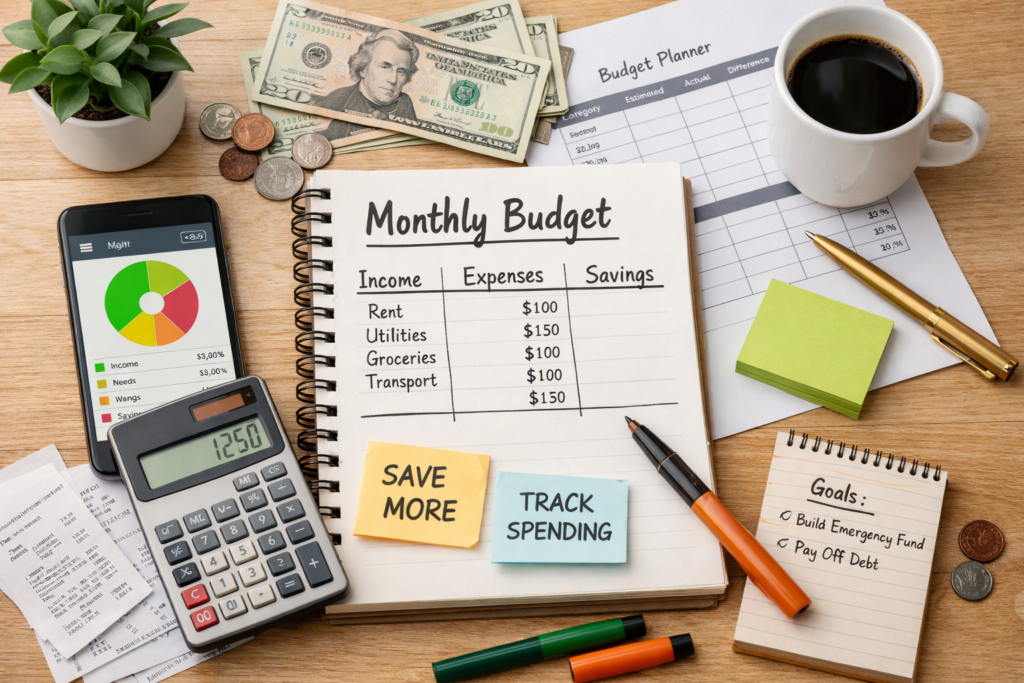
Managing your money doesn’t have to be complicated.
A monthly budget is simply a clear plan for where your money goes every month.
If you’ve ever reached the end of the month wondering “where did my money go?”, this guide is for you.
Below is a simple, practical, step-by-step method that works even if you’ve never budgeted before.
What Is a Monthly Budget?
A monthly budget is a plan that helps you:
- know how much money you earn
- decide how much you can spend
- make sure you save consistently
It’s not about restriction.
It’s about control and clarity.
A good budget tells your money what to do instead of wondering where it went.
Step 1: Calculate Your Monthly Income
Start with how much money actually comes in each month.
Include:
- salary (after taxes)
- freelance or side income
- any consistent extra income
If your income changes every month, calculate an average based on the last 3–6 months.
Be realistic. Only count money you are sure you will receive.
Step 2: List Your Fixed Expenses
Fixed expenses are bills that stay mostly the same every month.
Common examples:
- rent or mortgage
- utilities
- phone and internet
- insurance
- subscriptions
- loan payments
Write down the exact amount for each one.
This step shows you how much money is already committed before you spend on anything else.
Step 3: Estimate Your Variable Expenses
Variable expenses change month to month.
Examples:
- groceries
- transportation
- eating out
- entertainment
- shopping
Look at your bank statements from the last month or two.
Estimate an average amount for each category.
This step is where most people underestimate. Be honest with yourself.
Step 4: Set Savings Goals
Saving should not be “whatever is left”.
It should be planned.
Start with one priority:
- emergency fund
- future expenses
- long-term goals
Even a small amount matters.
Saving 5–10% of your income is enough to build the habit.
Consistency is more important than the amount.
Step 5: Choose a Budgeting Method
Use a method that feels simple, not stressful.
The 50/30/20 Rule
- 50% needs (housing, bills, food)
- 30% wants (fun, lifestyle)
- 20% savings
Zero-Based Budget
Every dollar has a job:
- income minus expenses equals zero
- nothing is unplanned
Simple Expense Tracking
- set limits for main categories
- adjust as you go
There is no “best” method.
The best budget is the one you actually follow.
Step 6: Track and Adjust Weekly
A budget is not something you set once and forget.
Once a week:
- check your spending
- compare with your plan
- adjust if needed
Life changes. Your budget should adapt.
Tracking weekly prevents small mistakes from becoming big problems.
Common Budgeting Mistakes to Avoid
- being too strict from the start
- forgetting irregular expenses
- not reviewing the budget
- giving up after one bad month
Budgeting is a skill.
You get better with practice.
Frequently Asked Questions
Do I need an app to budget?
No. A simple spreadsheet or notebook works perfectly.
How long does it take to see results?
Most people feel more control within the first month.
What if I fail to follow my budget?
That’s normal. Review it, adjust, and keep going.
Final Thoughts
A monthly budget is one of the most powerful financial tools you can use.
It gives you:
- clarity
- confidence
- peace of mind
Start simple. Improve over time.
Your future self will thank you.